How Many Baby Clothes Do I Need? The Honest Math
How many baby clothes do you need? The club’s honest math: enough to cover the days between laundry loads, plus a blowout buffer — for most families that’s roughly 10–15 bodysuits, 6–8 sleepers, and a small handful of everything else, per size. That’s it. That’s the formula. Everything below is the working: how laundry cadence drives the count, why sizes are a timeline rather than a measurement, and the categories the club consistently overbought and underbought. No pressure to buy more than you need — just the arithmetic nobody hands you.
The formula: laundry cadence × outfit changes
Baby clothing math has two inputs, and neither is on a registry:
- How often you’ll do laundry. Every two days? Multiply everything by two. Twice a week? Multiply by three or four. Be honest about the postpartum version of you, not the current version.
- Outfit changes per day. Newborns run through roughly two to three outfits a day once you count spit-up, leaks and the mysterious third thing. Club moms with “easy” babies report two; club moms with reflux babies report keeping count was the first thing to go.
So the real answer to “how many onesies” is changes per day × days between washes, plus a buffer of three or four. For a wash-every-three-days house, that’s around 10–12 bodysuits — which is why the club’s rule of thumb lands where it does.
The club’s counts, per size
Treat these as a starting grid, not gospel — every number here is “roughly,” because every baby and laundry schedule differs:
- Bodysuits/onesies: 10–15. The workhorse — a plain multipack (the Gerber Onesies bodysuits are the club’s stock-the-drawer standard) covers most of it. Short-sleeve or long depends on your season — think about what season the baby will be in that size, not the season now.
- Sleepers/footed pajamas: 6–8. In the early weeks these are day and night clothes. Nobody in the club regrets a zipper preference (the Simple Joys by Carter’s zip footed sleepers are the standard pick); several regret snaps, at length, at 3am.
- Pants or leggings: 4–6. They go over bodysuits and hide most sins between changes.
- Swaddles/sleep sacks: 2–4. One in the wash, one in use, one for the diaper bag (the HALO SleepSack is the club default).
- Socks and hats: a handful. Socks vanish into another dimension; hats mostly matter for weather and photos.
- Weather gear: 1 per size. One warm layer, one sun layer. The puffy snowsuit that fits for three weeks is the club’s most-cited waste of money.
- Fancy outfits: 1, maybe 2. Whatever arrives as gifts will cover the rest — dressy outfits are what people love to give and babies hate to wear.
The sizes are a timeline, not a wardrobe
The biggest planning mistake the club reports isn’t buying too many clothes — it’s buying them all in one size. Babies move through sizes at wildly different speeds; more than one club baby skipped “newborn” entirely, and at least one lived in it for two months.
- Newborn size: buy shallow. A week or two of coverage, tags on until worn, receipts kept. If your baby arrives big, you’ll be glad you didn’t stack the drawer.
- 0–3 months: this is the real starter size. Run the full formula here.
- 3–6 and up: buy as you go. Future sizes are where gift clothes pile up anyway, and buying ahead means guessing both size and season. Guess neither.
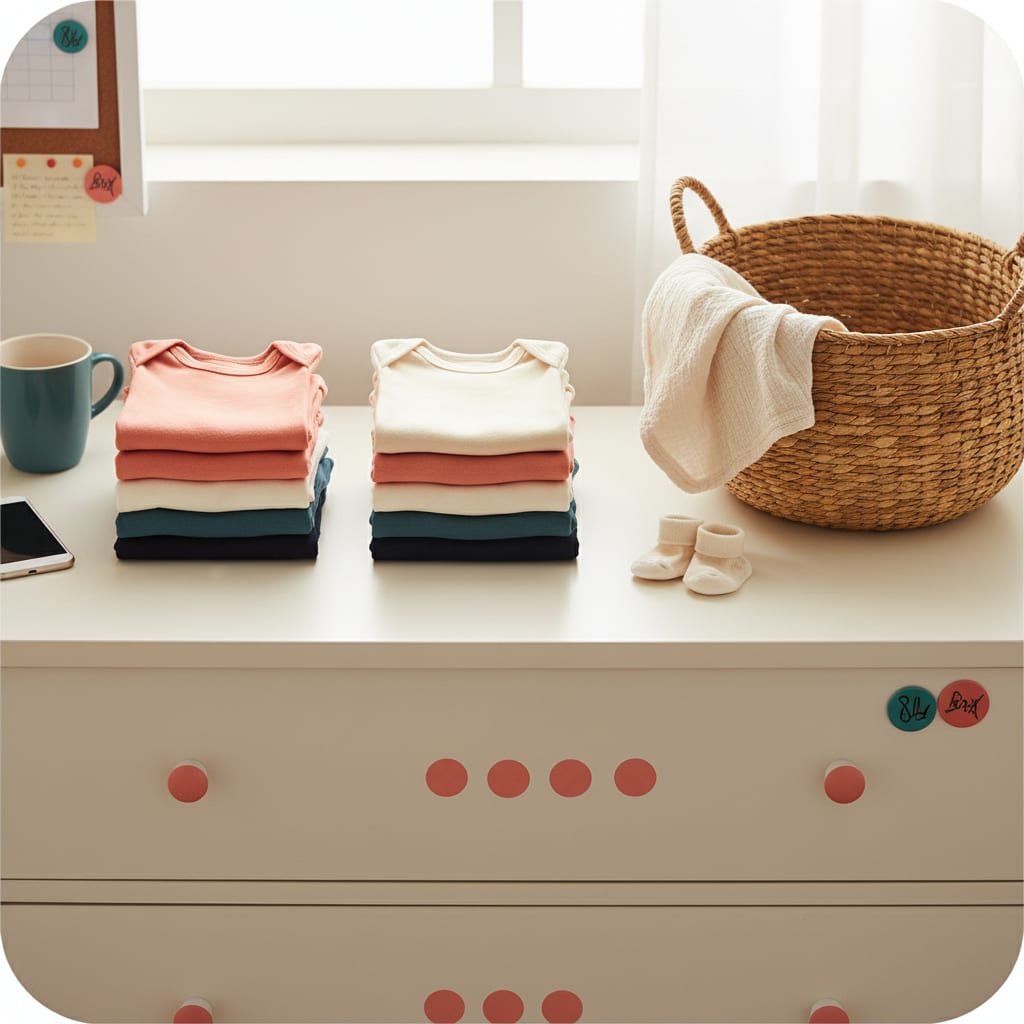
A drawer-per-size (or a labeled bin for the next size up) keeps the timeline visible — it’s a two-minute job that fits neatly into the nesting sweep on our third trimester checklist.
What the club overbought and underbought
Asked what they’d change, club moms answer with striking consistency. Overbought: newborn-size anything, dressy outfits, hats, and “adorable” items with buttons up the back. Underbought: plain bodysuits in the next size up, sleepers with zippers, and muslin cloths (the aden + anais muslin squares are the classic) — which aren’t clothes but absorb the consequences of them.
The other recurring lesson: clothes are the single easiest category to accept secondhand. Babies wear things for weeks, not years, and hand-me-downs arrive pre-softened. Say yes, keep what works, pass the rest along — and remember the counts above include borrowed items. The goal is coverage between laundry days, not ownership.
One more permission slip, because the club insists: you do not need the drawer to be ready before the baby comes. You need the first size ready. Everything else can be solved in week three by a friend with your list — which is exactly the kind of concrete job that belongs on the delegation list in our fourth trimester checklist.
Heard in the club: “I ironed newborn dresses while pregnant. She wore fruit-stained onesies and one sock. I regret nothing except the ironing.”
FAQ: baby clothes math
How many onesies do I need for a newborn?
Roughly 10–15 in the 0–3 month size covers most laundry schedules, with a shallow stack of true newborn size in case your baby arrives small. The formula: outfit changes per day (usually two to three) times days between washes, plus a small buffer.
How many newborn-size clothes should I buy?
Less than you think — enough for a week or two, tags on, receipts kept. Babies in the club skipped that size often enough that the standing advice is to start the real wardrobe at 0–3 months and adjust once you’ve met your actual baby.
How many sleepers does a baby need?
Around six to eight per size. In the early months sleepers are effectively the whole wardrobe — day shift and night shift — so they take the heaviest rotation of anything in the drawer. Club consensus favors zippers over snaps for anything worn at night.
Is it better to buy baby clothes before or after birth?
Buy the first size or two before, then buy as you go. Sizes are a timeline you can’t predict from the outside, gifts and hand-me-downs skew toward later sizes anyway, and restocking mid-year is a five-minute job — ideally someone else’s.