How to Swaddle a Newborn (Step by Step)
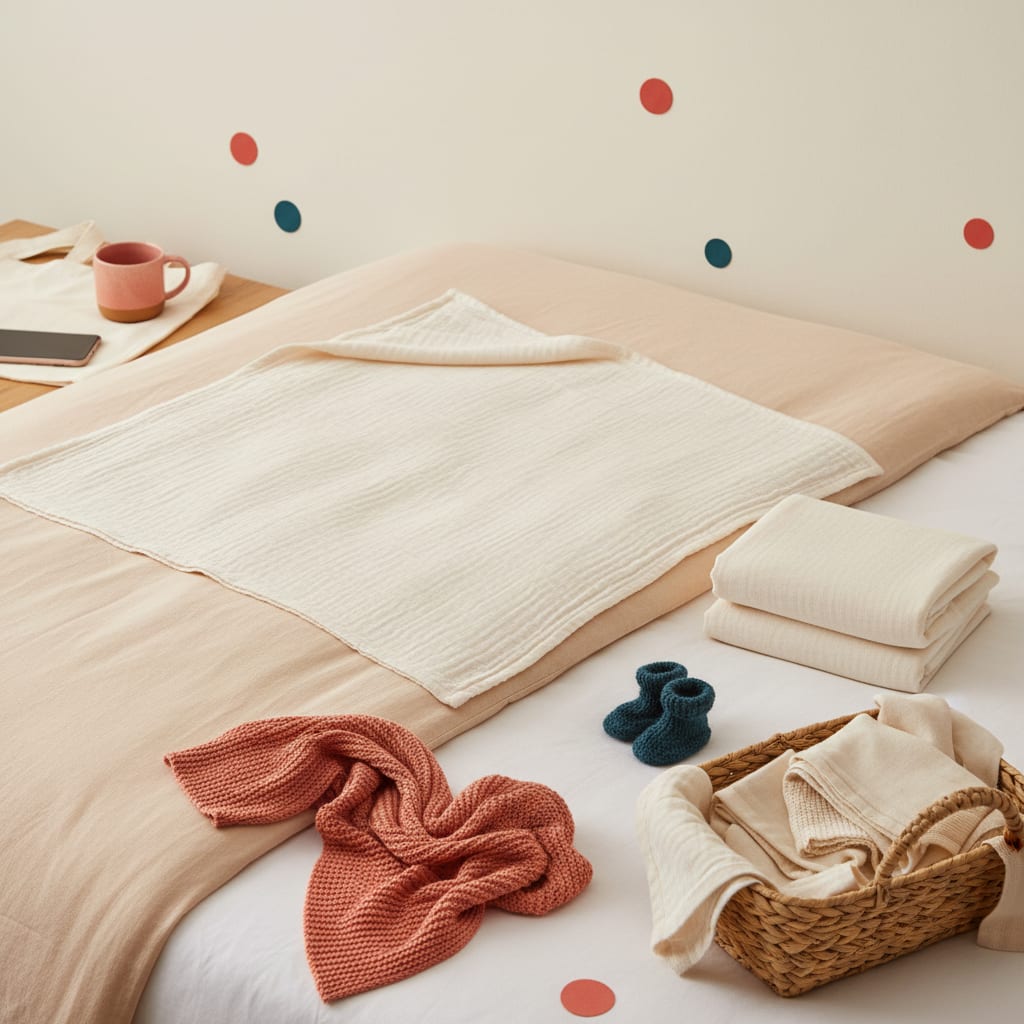
Lay a thin square blanket out as a diamond and fold the top corner down. Put the baby face-up with their shoulders just above that fold. Tuck one arm down, bring that side of the blanket across the body and under the opposite side. Fold the bottom corner up, loosely. Bring the last side across and tuck it in. Snug across the arms and chest, loose around the hips and legs, and a swaddled baby sleeps on their back, always. That’s the whole technique — here is each step, and the two things that actually matter.
The five steps
1. Diamond, top corner folded down. Spread a thin square blanket on a flat surface with one corner pointing up, then fold that top corner down eight to ten inches. You want a straight horizontal edge to lay the shoulders against. A stretchy jersey blanket is harder than it looks; plain woven muslin behaves best, which is why a set like the aden + anais Essentials four-pack ends up in so many club living rooms — four large, thin, square blankets is the right shape and the right weight for this.
2. Baby face-up, shoulders above the fold. Head clear of the blanket, shoulders sitting just above that folded edge. If the fold is up around the ears, refold lower. You are wrapping a body, never a head or a neck.
3. First arm down, first side across. Straighten one arm gently along the baby’s side, take the blanket corner on that same side, pull it firmly across the chest, and tuck the end underneath the opposite side of the body. Their own weight is what holds it. This is the step people do too gently the first ten times and then too tightly the next ten.
4. Bottom corner up — loosely. Fold the bottom of the blanket up over the feet and tuck it into the top of the wrap on one side. Leave real room down there. A newborn’s legs want to sit bent up and out, frog-style, and the bottom of a swaddle should never straighten them.
5. Second arm, last side across, tuck. Same as step three on the other side, and bring the tail of the blanket around the back. Done properly, the finished wrap looks like a small burrito with a slightly baggy bottom half.
If the whole business of moving a floppy newborn around still feels alarming, the five holds and the two rules behind them are worth reading first — swaddling is much easier once picking the baby up has stopped being a whole event.
Snug up top, loose at the hips
This is the rule underneath the steps, and it is the one that keeps a swaddle safe.
Up top: firm, not tight. The AAP’s test is that you should be able to slide at least two or three fingers between the baby’s chest and the blanket. If you can’t, it’s too tight. A swaddle that restricts the chest restricts breathing, and a wrap that is only snug at the arms does the actual job — the point is stopping the startle reflex from throwing their arms out and waking them.
Down below: genuinely loose. HealthyChildren.org, the AAP’s parent site, is blunt about why: studies have found that straightening and tightly wrapping a baby’s legs can lead to hip dysplasia or dislocation. The hips need to be able to bend and move inside the wrap. Whenever a mom in the club has described a swaddle that “looked so neat,” the neat part was usually the legs, and the legs are the part that should look sloppy.
Back sleeping is not optional
A swaddled baby goes down on their back, on a firm flat surface, in a bare crib or bassinet with nothing else in it, ideally in your room for the early months. That is not a swaddling rule with exceptions; it is the safe-sleep rule, and swaddling narrows it further, because a swaddled baby who ends up face-down cannot use their arms to move their head.
No sofa. No armchair. No recliner, however briefly, however awake you believe you are. If a loose swaddle blanket has worked its way up near the face, unwrap and start again rather than tucking it tighter.
The overheating part people miss
Wrapping a baby in an extra layer makes them warmer, which is obvious right up until 3am. The AAP flags sweating, damp hair, flushed cheeks, heat rash and rapid breathing as signs a baby is too hot. The practical version: the swaddle counts as one of the layers, not as a free extra. A onesie plus a thin muslin swaddle in a normally warm room is usually the whole outfit, and Betteroo’s guide to dressing a baby for the room they’re actually sleeping in is a sensible cross-check before you add a fleece anything.
When you stop
You stop swaddling at the first sign your baby is trying to roll — not when they roll, when they start working on it. Some babies begin that as early as two months. The same applies to sleep sacks that hold the arms or compress the chest. After that the standard next step is an arms-free wearable blanket, like the plain cotton HALO SleepSack, which keeps them warm without holding anything down. Betteroo’s write-up on reading the signals that swaddling has run its course goes deeper into the transition than we will here.

What the club learned by trial and error
Swaddle before the crying, not during it. Wrapping a baby who is already furious is a two-person job and a bad time for everyone. Most of the club moved swaddling to the beginning of the wind-down rather than the end.
Buy square, buy thin, buy several. One blanket is one laundry cycle away from no blanket, and the large thin square is the only shape that wraps properly.
The hospital swaddle looks different because they’ve done it ten thousand times. Yours will be lumpier for a fortnight. It works anyway.
Some babies simply refuse. A meaningful share of club babies hated the whole idea from day one, and no technique fixed it. That is a preference, not a failure, and it is worth knowing before you buy anything.
The first swaddle that actually holds until morning is a real, unmarked achievement — the kind that belongs on the list of new mom milestones nobody hands out stickers for. If you are still in the early setup weeks, the fourth-trimester checklist covers the rest of what the club sets up before the fog arrives.
FAQ: swaddling a newborn
Should a newborn’s arms be in or out of the swaddle?
Arms in is the standard, because pinning the arms is what stops the startle reflex waking them. Plenty of babies sleep better with one or both arms out, and that is fine — the same rules apply either way, and an arms-out wrap should still be snug across the chest and loose at the hips.
How tight should a swaddle be?
Firm enough that it stays put when the baby wriggles, loose enough that you can fit two or three fingers between their chest and the blanket, and loose enough at the bottom that their legs can bend up and out.
Can you swaddle a baby for naps as well as at night?
Yes, with the same conditions each time: on their back, on a firm flat surface, supervised in the sense that you know where they are and how they’re positioned. Naps in a car seat, swing or carrier are not swaddling situations at all.
What if the swaddle keeps coming undone?
Check step three — the end of the first side almost certainly isn’t tucked under the body far enough, so nothing is anchoring it. If it still escapes, a zip or velcro swaddle wrap does the same job with less origami. Persistent, determined breaking-out is also one of the earliest hints that the rolling stage is coming, so keep an eye on it.