Pumping at Work: Rights, Logistics & Real Schedules
Under the PUMP Act, most employees are entitled to reasonable break time to pump each time they need to, for one year after their child’s birth, plus a private space that is not a bathroom, shielded from view and free from intrusion. That’s the floor. Everything else is logistics: ask for the space in writing before your first day, block the sessions in your calendar like meetings, and decide in advance what you’ll do about the day the schedule collapses. Moms in the club who did those three things describe pumping at work as tedious. The ones who improvised describe it as the reason they stopped.
What the law actually gives you
The federal rules sit in the Fair Labor Standards Act, extended by the PUMP for Nursing Mothers Act. The Department of Labor’s own summary is short and worth reading in the original rather than in anyone’s paraphrase — including this one. The pieces that matter on a Tuesday morning:
- Break time, as often as you have need to pump, for up to one year after birth.
- A space that is not a bathroom. The DOL is explicit that a bathroom, even a private one, is not a permissible location. It has to be shielded from view and free from intrusion by coworkers and the public.
- Pay. Employers must either relieve you fully from duty during the break or pay you for it — and if paid breaks already exist at your workplace, a pumping break during that time is paid on the same terms.
- An exemption. Employers with fewer than fifty employees may be exempt if compliance would be an undue hardship given the size and resources of the business.
- Enforcement runs through the DOL’s Wage and Hour Division, and your state may give you more than the federal floor. Check yours; several do.
Your employer’s own policy may be more generous. Ask HR for it in writing — the club’s experience is that a written policy exists more often than managers know.
Ask for the space before your first day back
The single most repeated regret here is asking on the morning of day one, standing in a hallway, with a full bag. That’s how club moms ended up in supply cupboards and parked cars for a month.
Send a short email a week out. It does not need to be apologetic or detailed:
“I’m back on the 15th. I’ll need to pump roughly every three hours — could you confirm which room I should use and how it’s booked? Happy to work around meetings where I can.”
That email does three quiet things: it creates a record, it gives the answer time to arrive before you do, and it moves the conversation from a favour to a scheduling detail. Put it on the maternity leave checklist alongside the benefits deadlines, because it belongs to the same last-fortnight block.
Then look at the room before your first day if you can. Check for a lock, an outlet, a surface, and whether the door has a window in it. Every one of those has been a problem for somebody.
What a pumping day actually looks like
There is no universal schedule; there’s the shape of your job. Three versions the club runs:
The desk job
Sessions mid-morning, early afternoon and late afternoon, blocked in the calendar as private appointments with a name that isn’t “pumping” if you’d rather. Fifteen to twenty minutes each, plus the walk. The trick that makes it survivable is booking the room for the whole block rather than the pumping part, so a meeting that runs over doesn’t eat it.
The shift or classroom job
You get the breaks the day gives you, which means the plan is built around fixed cover rather than fixed times. Agree the cover before you start — with a named person, not “we’ll sort it.” Club moms in teaching and nursing consistently say this is the version that needs a manager’s involvement rather than a manager’s permission.
The hybrid week
Easier and more chaotic. Home days are relaxed, office days are compressed, and supply notices the difference. The usual fix is to keep office days as consistent as possible week to week rather than letting them float.
Whatever the shape: put the sessions in the calendar before anyone else fills the day. A blocked slot gets respected; an intention does not.
The kit that makes the day workable
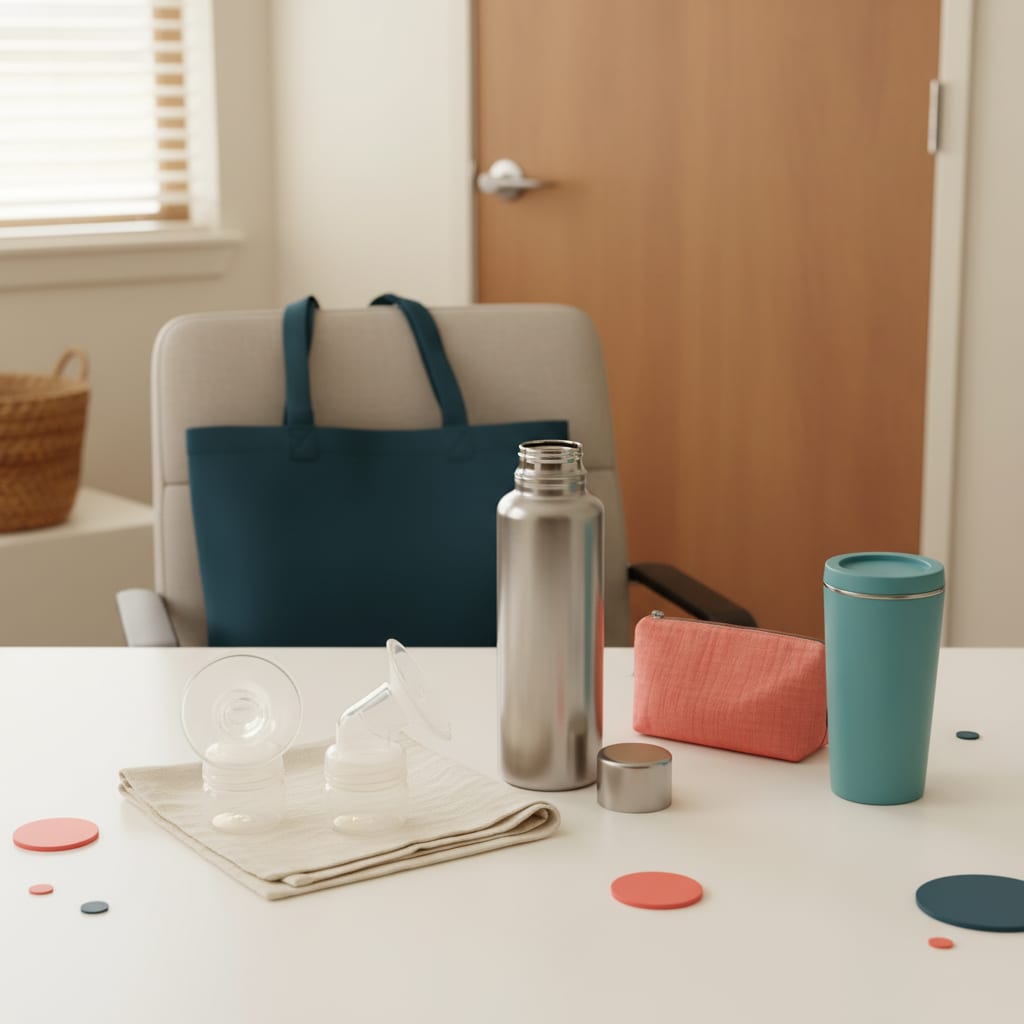
This is a logistics post, not a gear review, so: you need a way to pump, a way to keep milk cold, and a way to carry the parts without a sink. That’s it.
The cold-storage question is the one people underestimate, because the office fridge is a social object as much as a cold one. If you’d rather not have that conversation at all, an insulated chiller bottle solves it — the Ceres Chill is the one that comes up most in the club, because it’s a single container that connects to most pumps and lives in your bag rather than in a communal fridge. If your workplace fridge is fine, use it; label the bottles and don’t overthink it.
Two spare sets of pump parts beat any cleaning system, because a workplace sink is not somewhere you want to be assembling anything. Rinse at work, wash properly at home.
When it stops working
It will wobble at some point — a week of missed sessions, a travel day, a stomach bug. The club’s honest position is that a dip is a dip and not a verdict, and that questions about supply, weaning a session, or anything that feels medical belong with a lactation consultant or your doctor rather than a blog or a group chat.
What is in our lane: if the room keeps being unavailable, or the breaks keep being scheduled over, that’s a workplace problem with a legal floor underneath it. Raise it in writing, early, before it becomes six weeks of resentment.
Give the first fortnight lower stakes
Expect to be slower than you planned, expect one session to be missed, and expect to feel oddly emotional about the whole thing in a way nobody warned you about. That’s the same curve as everything else in the return, and the club’s collected version of it lives in what to expect from your first week back and in the wider back-to-work playbook.
The moms who came out of it happiest weren’t the ones who pumped the most. They were the ones who decided, in advance, what “enough” looked like for them — and then stopped renegotiating it at 3pm on a bad day.

Heard in the club: “I emailed about the room a week early and got a key, a lock and an apology. My friend asked on day one and got a store cupboard for a month. Same company.”
FAQ: pumping at work
How often will I need to pump at work?
Most club moms settle around every three hours or so across a standard day, which usually means two or three sessions — but it varies by baby, by age and by person. Start with roughly the spacing your baby feeds at, then adjust once you see what the day actually allows.
Does my employer have to pay me for pumping breaks?
Under federal rules, an employer must either relieve you completely from duty during the break or pay you for the time. If your workplace already offers paid breaks, using one to pump is paid on the same basis as anyone else’s break. State law may be more generous than the federal floor.
Can my employer make me pump in a bathroom?
No. The Department of Labor is explicit that a bathroom is not a permissible location, even a private one. The space must be shielded from view and free from intrusion from coworkers and the public. If the only offer is a bathroom, that’s the point to put your request in writing.
What if I work somewhere with no spare room at all?
Small employers can claim an undue-hardship exemption, but “we don’t have a room” is not automatically that — plenty of workplaces solve it with a lockable office on a booking sheet or a screened corner. Ask what can be arranged rather than whether a dedicated room exists, and get the answer in writing either way.