Bedtime in an Open-Plan House (When There's No Door)
In an open-plan house the answer is not a door — it is deciding which room is the sleep room and which is the evening room, and accepting that for a while they cannot be the same room. In practice the baby’s sleep space goes in the bedroom you actually close, and the adults’ evening moves to whatever corner of the plan sits furthest from it. Then you handle sound on purpose instead of tiptoeing and hoping. Here is how the club runs an evening in a house with no walls.
What open plan actually costs you at 7pm
Nobody chooses an open plan for the acoustics. You choose it so you can see the whole family at once and never be shut in a kitchen alone again — all true right up until the third week of a bedtime routine, when you discover that one continuous space is also one continuous sound space.
Be precise about the constraint, because it isn’t the one people assume. This isn’t a small-space problem; plenty of moms in the club have more square footage than they know what to do with. The problem is that the footage is undivided — no hallway between the noise and the sleeping, no second reception room, no door at the bottom of the stairs. A small older house with three doors on the ground floor is easier to run a bedtime in than a huge great room. Doors, not floor area, are what you’re short of — and you can’t make up the difference with quiet, because nobody holds a household at whisper volume for four hours a night.
The sleep room is the room with a door
For most of the first year this answers itself. HealthyChildren.org, the American Academy of Pediatrics’ parent site, advises keeping your baby’s sleep area in the same room where you sleep — but not the same bed — for at least the first six months. Your bedroom has a door. That’s the sleep room, and it’s the recommendation, not a compromise.
The trap is specific. Because the great room is where the family lives, it feels natural to keep the bassinet down there all evening. That’s a fine arrangement — but not the version it drifts into, where an adult dozes on the sofa with the baby on their chest because moving means crossing the house. The same AAP page states that the risk of sleep-related infant death is “up to 67 times higher when infants sleep with someone on a couch, soft armchair or cushion.” A sofa is not a sleep surface, however close it is to where you’re standing.
The surface rules hold wherever you put it: firm and flat, nothing in it but a fitted sheet, no incline over ten degrees. If you’re eyeing the corner behind the sofa as a nursery substitute, ask whether it can hold a proper separate sleep surface — if not, it isn’t a sleep space, it’s a parking spot. Betteroo’s guide to whether babies actually sleep better once they have a room of their own is worth reading when you start blaming the layout for your nights.
Where the adults go
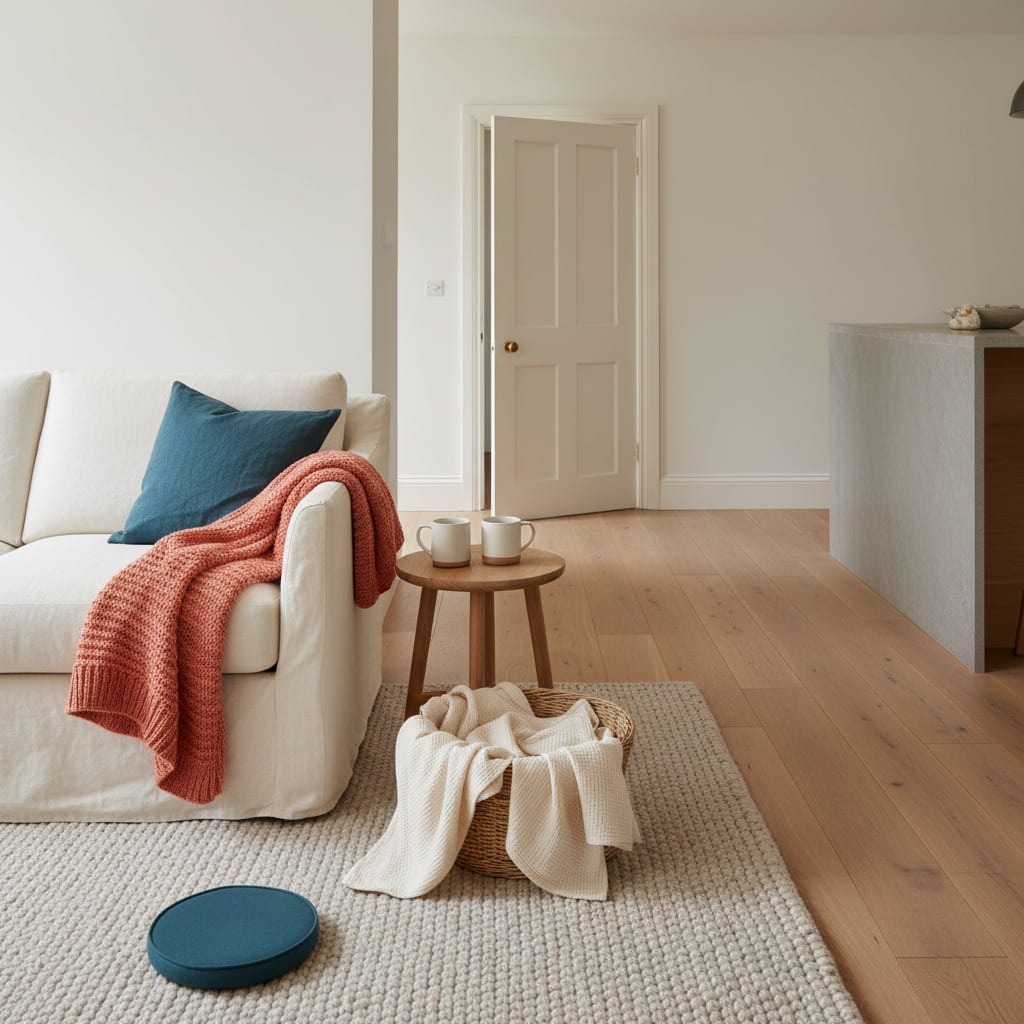
This is the half nobody plans and everybody resents. Once the sleep room is chosen, the evening has to move somewhere real — not the sofa nearest the stairs with the TV on mute. Pick the furthest corner from the sleep room, commit to it, and make it somewhere you’d actually sit: one lamp you like, a surface for a mug, the good blanket. A mom in the club rearranged her whole living end around this — sofa turned ninety degrees, two lamps moved — and said it was the first thing in four months that made the evening feel like hers instead of like waiting.
Then be honest about what’s leaving: the dishwasher after seven, TV at a volume you can feel, the coffee grinder, the doorbell. Pretending that isn’t a loss is how it curdles.
The club’s rule is to name the two things you are not giving up and engineer around those. One household kept dinner together at eight and moved every noisy machine to a 6:15 run. Another kept the TV and bought the bedtime parent good headphones so the trade felt even. Two is achievable; five ends in a row.
Guests are the same problem in miniature: there’s nowhere to send people still talking at eight, so say the shape of the evening out loud when you invite them. Our guide to house rules for overnight guests scales that up to people still there in the morning.

Give the house a floor of sound
The instinct is silence, and silence is the wrong target: in a genuinely quiet house every noise becomes an event — the fridge compressor, a chair leg, a car outside. What you want is a steady floor of sound that ordinary household noise doesn’t stick out above.
A plain white-noise machine does that, and does it better placed between the sleeping baby and the noise than parked beside the crib. The classic worked example is the Dohm, which makes its sound from a real fan rather than a loop, so there’s no seam to notice. Set the volume as a conversation with your household: it should mask the kitchen, not replace it.
Then spend twenty minutes on the door you do have: felt pads on the frame, the latch that clicks, the hinge that announces every check. Where one door does all the work, maintain it like equipment. And turn the doorbell off at 6:30 — in the club, that’s the single change people report back on most.
The evening rota when one adult disappears
Open plan has a social side effect a two-story house doesn’t. When the settling adult shuts the door they vanish completely — no half-presence on the stairs, no shouting a question down — while the other sits in a warm lit room with a drink. Three nights of that and somebody is keeping score.
What holds up:
- Alternate on a fixed pattern, not on who seems less wrecked. “Whoever can face it” always resolves to the same person.
- The downstairs adult owns the reset — kitchen done, bags packed, tomorrow’s coffee. Nobody should come out of bedtime into a job.
- Hand over properly — where the feed got to, what happened, what you already tried. Our fair-split playbook is the longer version of the same argument.
- Protect the late shift. Whoever does a 10pm feed here goes to bed at eleven in a house where everything is audible, and when that shift moves the whole evening rearranges — which is what our post on dropping the 10pm dream feed is really about.
The evening contact nap, which becomes a system
Here’s the sequence open-plan houses produce more than anywhere else. The baby falls asleep on somebody at six. Nobody moves them, because moving means crossing the house. By 7:30 it’s The Way We Do It, and by week three that adult hasn’t eaten a hot meal.
An intentional contact nap and an accidental one are different things — Betteroo’s guide to holding a baby for naps and when to move away from it is fair on both. The hard line is the one above: an adult who might fall asleep too is not a sleep surface, and the sofa never is. How you move a baby who settles best in arms is settling mechanics, not architecture, and belongs to your pediatrician rather than a post about your floor plan.
FAQ
Can our baby just sleep in the living room? As a daytime nap space with a proper firm, flat, separate surface, plenty of households do. For night sleep in the first six months the AAP guidance is the baby’s sleep area in your room — and the living end is where the noise and the front door are.
Would a room divider or a curtain track help? For light, yes — a heavy curtain across an opening kills a surprising amount of spill. For sound, expect very little: a curtain is not a wall.
When do we get our evening back? Usually when the baby moves to their own room and the house gains a second door — for many club households, somewhere in the second half of the first year. Knowing that’s the milestone you’re waiting on makes the interim feel like a stretch rather than your life.